What Would Happen if the Us Was Attacked Again

The concept of an invasion of the U.s. relates to armed forces theory and doctrine which address the feasibility and practicality of a strange power attacking and successfully invading the U.s.. The state has been physically invaded a few times – once during the State of war of 1812, in one case during the Mexican–American War, several times during the Mexican Border War, and three times during World War Ii, two of which were air attacks on American soil. During the Cold War, most of the US military strategy was geared towards repelling an assault past the Soviet Union.[1]
Early on attacks [edit]
The war machine history of the United States began with a foreign power on US soil: the British Regular army during the American Revolutionary War. Later on American independence, the next attack on American soil was during the War of 1812, likewise with United kingdom of great britain and northern ireland, the first and just time since the end of the Revolutionary War in which a foreign ability occupied the American capital letter (the upper-case letter city of Philadelphia was also captured by the British during the Revolution).
On April 25, 1846, Mexican forces invaded Brownsville, Texas, which they had long claimed as Mexican territory, and attacked Us troops patrolling the Rio Grande in an incident known equally the Thornton Thing, which sparked the Mexican–American State of war. The Texas Campaign remained the only campaign on American soil, and the rest of the action in that conflict occurred in California and New Mexico, which were then part of Mexico, and in other parts of Mexico.
The American Civil War may be seen as an invasion of home territory to some extent since both the Confederate and the Marriage Armies made forays into the other's home territory. Subsequently the Civil State of war, the threat of an invasion from a foreign power was small-scale, and it was not until the 20th century that any existent military strategy was developed to address the possibility of an attack on America.[2]
During the Mexican Revolution in the summer of 1915, Mexican and Tejano rebels covertly supported past the Mexican Government of Venustiano Carranza, attempted to execute the Programme of San Diego past reconquering Arizona, New Mexico, California, and Texas and creating a racial utopia for Native Americans, Mexican Americans, Asian Americans, and African Americans. The plan also called for ethnic cleansing in the reconquered territories and the summary execution of all white males over the age of sixteen.[3] In social club to implement the Plan, the rebels set off the Bandit State of war and conducted vehement raids into Texas from across the Mexican border. Under pressure from his advisors to appease Carranza, U.S. President Woodrow Wilson recognized the latter as leader of Mexico in render for Carranza's "assist" in suppressing the Texas border raids.
On March ix, 1916, Mexican revolutionary Pancho Villa and his Villistas retaliated for the Wilson Assistants'due south support of Carranza by invading Columbus, New United mexican states in the Edge War's Battle of Columbus, triggering the Pancho Villa Expedition in response, led by Major General John J. Pershing.[4]
When it was captured and leaked to the American press past British Intelligence, the Imperial German Foreign Office's offering in the Zimmermann Telegram to support Carranza's expansionist aims, as laid out in the Plan of San Diego, in return for a potential wartime alliance against the United States, led the U.S. to declare war on Royal Frg and enter World War I on the Allied side.
European threats [edit]
Until the early 20th century, the greatest potential threat to assail the United States was seen as the British Empire. Seacoast defense in the U.s. was organized on that basis, and military strategy was developed to forestall a British attack and attack and occupy Canada. "State of war Plan Cherry" was specifically designed to deal with a British attack on the Us and a subsequent invasion of Canada. Like plans[5] existed for a 20th-century state of war with Mexico, although the ability of the Mexican Ground forces to set on and occupy American soil was considered negligible.
Within the British Empire, Canadian Army Lieutenant Colonel James "Buster" Sutherland Chocolate-brown drafted the Canadian analogue of War Program Cherry, Defence Scheme No. 1, in 1921. Co-ordinate to the program, Canada would invade the U.s.a. as chop-chop as possible in the event of war or a The states invasion. The Canadians would gain a foothold in the Northern United states of america to allow time for Canada to prepare its war endeavour and receive help from Britain. Co-ordinate to the plan, Canadian flying columns stationed in Pacific Command would immediately be sent to seize Seattle, Spokane, and Portland. Troops stationed in Prairie Command would attack Fargo and Great Falls and then advance towards Minneapolis. Troops from Quebec would exist sent to seize Albany in a surprise counterattack while troops from the Maritime Provinces would invade Maine. When American resistance grew, the Canadian soldiers would retreat to their own borders, destroying bridges and railways to delay US armed forces pursuit. The program had detractors, who saw it every bit unrealistic, but information technology also had supporters who believed that it could feasibly have worked. On the reverse side of the Atlantic, the British Armed Forces generally believed that if war with the U.s.a. did occur, they could transport troops to Canada if asked, just nevertheless saw it every bit impossible to defend Canada against the much larger and powerful Usa. They did non programme to render whatever real aid and felt that sacrificing Canada to divert troops and buy fourth dimension would be in the best military interests of the British Empire. A full invasion of the United States was considered unrealistic and a naval blockade was seen as likewise deadening. The Royal Navy also could not afford a defensive strategy because Peachy Britain was extremely vulnerable to a supply occludent and if the much larger United States Navy approached the British Isles, the United kingdom of great britain and northern ireland would exist forced to immediately give up. The British Loftier Command planned instead for a decisive naval battle against the United States Navy by Royal Navy ships based in the Western Hemisphere, likely Bermuda. Meanwhile, other ships based in Canada and the British West Indies would attack American merchant shipping and protect British and Commonwealth shipping convoys. The British would also assail U.Due south. coastal bases with bombing, shelling, and amphibious assaults. Soldiers from British Bharat and Australia would provide assistance with an assail on Manila to prevent Us Asiatic Armada attacks against British merchant ships in the Far Eastward and to preempt a potential assault confronting the Colony of Hong Kong. The British Regime hoped that these policies would make the war unpopular enough amongst Americans to force the U.Due south. government to hold to a negotiated peace.[half-dozen]
Meanwhile, Purple German plans for the invasion of the United States were drafted, like virtually war plans, as military logistical exercises between 1897 and 1906. Early versions planned to engage the United States Atlantic Fleet in a naval battle off Norfolk, Virginia, followed by shore bombardment of cities on the Eastern Seaboard. Later versions envisioned amphibious landings to seize control of both New York City and Boston. These plans, even so, were never seriously considered, because the German language Empire had insufficient soldiers and armed services resources to comport them out successfully. In reality, the foreign policy of Kaiser Wilhelm Two sought to maintain good relations and avoid unnecessarily antagonizing the United States, while also limiting United states of america ability to intervene in Europe. This policy continued, however, until the U.Southward. entered World War I in 1917, just with ane alteration.
From August 1914 until April half-dozen, 1917, when the U.s. ended its neutrality, German military machine intelligence officers and spies under diplomatic cover worked covertly to both filibuster and destroy military supplies being built by American munitions corporations and shipped to the Allied Powers. These efforts culminated in demolition operations similar the Black Tom explosion (July 30, 1916) and the Kingsland explosion (Jan 11, 1917).
Earth War II [edit]
During Earth War II, the defence of Hawaii and the continental United States was role of the Pacific theater and American theater respectively. The American Campaign Medal was awarded to military personnel who served in the continental The states in official duties, while those serving in Hawaii were awarded the Asiatic-Pacific Campaign Medal.
Nazi Federal republic of germany [edit]
When Federal republic of germany alleged war on the U.S. in 1941, the German High Command immediately recognized that current German military forcefulness would exist unable to assault or invade the The states directly. Armed forces strategy instead focused on submarine warfare, with U-boats hit American shipping in an expanded Boxing of the Atlantic, particularly an all-out assault on U.Due south. merchant shipping during Performance Drumbeat.
Adolf Hitler dismissed the threat of America, stating that the country had no racial purity and thus no fighting forcefulness, and further stated that "The American public is made up of Jews and Negroes".[seven] German military and economic leaders had far more than realistic views, with some such as Albert Speer recognizing the enormous productive capacity of America'due south factories as well as the rich food supplies which could be harvested from the American heartland.[viii]
In 1942, German military leaders did briefly investigate and consider the possibility of a cross Atlantic assail against the U.Due south.—most cogently expressed with the RLM's Amerika Bomber trans-Atlantic range bomber design contest, beginning issued in the leap of 1942—proceeded forward with simply v airworthy prototype aircraft created between ii of the competitors, but this plan had to be abandoned due to both the lack of staging bases in the Western Hemisphere, and Germany'southward own chop-chop decreasing capacity to produce such aircraft equally the state of war wore on. Thereafter, Germany's greatest hope of an attack on America was to wait to run into the outcome of that nation's war with Japan. By 1944, with U-Boat losses soaring and with the occupation of Greenland and Iceland, it was clear to the German armed forces leaders that the dwindling German language armed forces had no further promise to attack the United states of america directly. In the cease, German military strategy was in fact geared toward surrendering to America, with many of the Western Front battles fought solely for the purpose of escaping the advance of the Ruby-red Army and surrendering instead to the Western Allies.[ix]
One of the only officially recognized landings of High german soldiers on American soil was during Performance Pastorius, in which 8 High german demolition agents were landed in the United states of america (1 team landed in New York, the other in Florida) by U-Boats. The team was quickly captured and put on trial equally spies, rather than prisoners-of-war, due to the nature of their consignment. After the courtroom constitute them guilty of espionage, half dozen High german agents were executed in the electric chair at the Washington, D.C. jail. The other two were not put to death and instead received prison terms because they willingly turned on their comrades by defecting to the United States and told the FBI nigh the mission'due south programme. In 1948, three years after World War II ended, the two were freed and returned to then Allied-occupied Germany, later to be divided between Westward and E Frg.
The Luftwaffe began planning for possible trans-Atlantic strategic bombing missions early in World War Ii, with Albert Speer stating in his own post-state of war volume, Spandau: The Cloak-and-dagger Diaries, that Adolf Hitler was fascinated with the idea of New York City in flames. Before his Machtergreifung in January 1933, Hitler had already, in 1928, idea that the United States would be the next serious foe the future Third Reich would need to face up, after the Soviet Union.[10] The proposal by the RLM to Germany's military aviation firms for the Amerika Bomber projection was issued to Reichsmarschall Hermann Göring in the late spring of 1942, almost six months after the set on on Pearl Harbor, for the contest to produce such a strategic bomber pattern, with only Junkers and Messerschmitt each building a few airworthy prototype airframes earlier the state of war'due south finish.
Purple Japan [edit]

The feasibility of a total-scale invasion of Hawaii and the continental The states by Purple Nippon was considered negligible, with Japan possessing neither the manpower nor logistical ability to practice so.[11] Minoru Genda of the Imperial Japanese Navy advocated invading Hawaii subsequently attacking Oahu on December vii, 1941, believing that Japan could apply Hawaii as a base to threaten the continental United states, and perhaps as a negotiating tool for ending the war.[12] The American public in the commencement months later the assault on Pearl Harbor feared a Japanese landing on the W Coast of the U.s., eventually reacting with alarm to a rumored raid in the Battle of Los Angeles. Although the invasion of Hawaii was never considered by the Japanese armed forces afterward Pearl Harbor, they did carry out Operation M, a mission on March 4, 1942, involving two Japanese aircraft dropping bombs on Honolulu to disrupt repair and salvage operations following the set on on Pearl Harbor three months earlier, which only caused small damage.
On June 3/4, 1942, the Japanese Navy attacked the Territory of Alaska as part of the Aleutian Islands Campaign with the bombing of Dutch Harbor in the city of Unalaska, inflicting destruction and killing 43 Americans. A few days afterward, vi,000–vii,000 Japanese troops landed and occupied the Aleutian Islands of Attu and Kiska; they were driven out entirely a year later on between May and August 1943 by U.S. and Canadian forces.[13] [14] The Aleutian Islands campaign in early June 1942 was the only foreign invasion of U.S. soil during Earth State of war 2 and the offset significant foreign occupation of American soil since the War of 1812.[xv] Japan also conducted air attacks through the apply of burn down balloons. Six American civilians were killed in such attacks; Japan also launched 2 manned air attacks on Oregon as well as ii incidents of Japanese submarines shelling the U.S. West Coast.[16]
Although Alaska was the only incorporated territory invaded by Japan, successful invasions of unincorporated territories in the western Pacific shortly subsequently Pearl Harbor included the battles of Wake Isle, Guam, and the Philippines.
Cold War [edit]

FEMA-estimated primary targets for Soviet nuclear attacks during the height of the Cold State of war.
During the Cold War, the principal threat of an attack on the United states was viewed to exist from the Soviet Matrimony. In such an set on, nuclear warfare was projected to almost certainly happen, mainly in the grade of intercontinental ballistic missile attacks equally well as Soviet Navy launches of SLBMs at Us coastal cities.[17]
The first Cold State of war strategy against a Soviet attack on the United States was developed in 1948 and was made into an even firmer policy afterwards the Soviet evolution of the nuclear weapon in 1949. By 1950, the Usa had adult a defense force program to repel a Soviet nuclear bomber force through the use of interceptors and anti-aircraft missiles and to launch its own bomber fleet into Soviet airspace from bases in Alaska and Europe. By the end of the 1950s, both Soviet and US strategy included nuclear submarines and long range nuclear missiles, both of which could strike in just ten to 30 minutes; bomber forces took as long equally 4 to six hours to accomplish their targets. The concept thus developed of the nuclear triad of all 3 weapons platforms (state based, submarine, and bomber) being coordinated in unison for a devastating first strike, followed by a counterstrike that would be accompanied by "mopping upward" missions of nuclear bombers.
Operation Washtub was a summit hole-and-corner joint performance between the United States Air Strength and the Federal Bureau of Investigation. Primarily lead by FBI director J. Edgar Hoover and then his protégé Joseph F. Carroll, the operation was carried out with the primary goal of leaving stay-behind agents in Alaska Territory for covert intelligence gathering, with a secondary goal of maintaining evasion and escape facilities for US forces.
On June 22, 1955, a US Navy P2V Neptune with a crew of 11 was attacked past two Soviet Air Forces fighter aircraft along the International Appointment Line in international waters over the Bering Straits, between Siberia'south Kamchatka Peninsula and Alaska. The P2V crashed on the island's northwestern greatcoat, near the village of Gambell. Villagers rescued the crew, iii of whom were wounded by Soviet fire and four of whom were injured in the crash.
American nuclear warfare planning was nearly put to the test during the Cuban Missile Crunch. The subsequent blockade of Cuba also added a fourth element into American nuclear strategy: surface ships and the possibility of low-yield nuclear attacks confronting deployed fleets. Indeed, the United states of america had already tested the feasibility of nuclear attacks on ships during Operation Crossroads. Reportedly, one Soviet submarine nearly launched a nuclear torpedo at an American warship, simply the three officers required to initiate the launch (the helm, the executive officer Vasily Arkhipov, and the political officer) could not agree to practise so.
By the 1970s, the concept of mutually-assured destruction led to an American nuclear strategy that would remain relatively consequent until the end of the Cold War.[18]
Modern era [edit]
In of 21st-century warfare, The states strategic planners take been forced to contend with various threats to the United States, including straight attack, terrorism, and unconventional warfare such every bit a cyberwarfare or economic assault on American investments and fiscal stability.
Directly assault [edit]
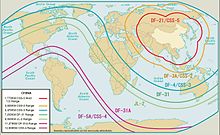
Range of China'southward nuclear missiles. Cathay is capable of a nuclear assail on almost of the world'due south countries, including the United States.
Several modern armies operate nuclear weapons with ranges in the thousands of kilometers. The The states is therefore vulnerable to nuclear attack by powers such as the United Kingdom,[19] Russia, China,[xx] France, and Bharat. However, the United kingdom and France are both members of NATO and longtime United states allies while India is a Major Defense Partner of the Usa and a member of the Quad so an attack on the Us by any of these countries is extremely unlikely.
The United States Northern Control and the U.s.a. Indo-Pacific Control are the peak U.s. military machine commands overseeing the defense of the Continental US and Hawaii, respectively.
Cyberwarfare and economic attacks [edit]
The risk of cyberattacks on noncombatant, government, and military computer targets was brought to lite afterward Prc became suspected of using regime-funded hackers to disrupt American cyberbanking systems, defense industries, telecommunication systems, power grids, utility controls, air traffic and train traffic control systems, and certain military systems such as C4ISR and ballistic missile launch systems.[21]
Attacks on the US economic system, such as efforts to devalue the dollar or corner merchandise markets to isolate the United States, are currently considered another method by which a strange power may seek to attack the country.
Geographic feasibility [edit]
Many experts have considered the Us impossible to invade because of its major industries, reliable and fast supply lines, large geographical size, geographic location, population size, and hard regional features. For instance, the deserts in the Southwest and the Great Lakes in the Midwest insulate the country'due south major population centers from threats of invasion. An invasion from outside North America would require long supply bondage beyond the Pacific or Atlantic Oceans for a nifty reduction of overall power. Notably, no nation-state has enough power to threaten the US on the North American continent since Canada and Mexico relish generally friendly relations with the US and are militarily weak in comparison.[22] [23]
Military expert Dylan Lehrke noted that an amphibious assault on either the West Declension or the E Coast is merely besides insignificant to get a beachhead on both coasts. Fifty-fifty if the foreign ability managed to go undetected in light of modern surveillance capability, it withal could not build up a force of whatsoever size earlier it was pushed dorsum into the sea. In improver, Hawaii is largely protected by the 40,000-potent U.s. war machine with valuable assets, which acts every bit a huge deterrent to any strange invasion of the island state and thereby the Continental US.[24] Thus, the invasion of the continent would take to come up from the country borders through Canada or Mexico. An attack from Mexico is possible, but California and Texas have the largest concentration of defense industries and armed forces bases in the country and provide an effective deterrent from any assail, with the Southwestern desert finer dividing any invasion into ii. An attack launched from Canada on the Midwest or the West would be limited to low-cal infantry and would fail to have over population centers or other important strategic points since at that place are generally rural farmland and unpopulated national parks along the edge and powerful airbases located hundreds of miles south. That provides United states armed services personnel or militias an reward to conduct guerrilla warfare. This has resulted in many referring to the US as uninvadable.[25]
In popular culture [edit]
A number of films and other related media have dealt with fictitious portrayals of an attack against the US past a strange power. I of the more well-known films is Red Dawn, detailing an attack against the United states of america past the Soviet Union, Cuba, and Nicaragua. A 2012 remake details a similar attack, launched by Democratic people's republic of korea and ultranationalists controlling Russia. Other films include Invasion U.S.A., Olympus Has Fallen, and White Firm Down. The Solar day After and By Dawn'due south Early Light, both of which detail nuclear war between Usa and Soviet forces. Another film that shows an invasion of the US was the 1999 film South Park: Bigger, Longer & Uncut in which Canadian forces invade the main characters' hometown in Colorado. A bloodless Soviet takeover aftermath is depicted in the 1987 miniseries Amerika.
Invasion U.S.A. is a 1985 American activity flick made by Cannon Films starring Chuck Norris. It was directed by Joseph Zito. Information technology involves the star fighting off a forcefulness of Soviet and Cuban-led guerrillas.
In Philip G. Dick'southward The Man in the High Castle, the U.s. is occupied by both Nazi Germany and Imperial Japan, which are separated by a neutral zone, after invasions of both the West Declension and the East Coast.
A terrorist occupation of Washington, D.C. was the subject of a G.I. Joe cartoon episode, when Serpentor led Cobra forces to occupy the American capital. A terrorist occupation of the capital was also seen in G.I. Joe: Retaliation. In The Simpsons' episode "Y'all Only Motion Twice," series protagonist Homer Simpson goes to piece of work for what he doesn't know is a terrorist organisation, whose leader threatens extreme violence and destruction in the mainland if various demands are not met; in the end, the terrorists seize control of the U.S. East Coast.
In the video game Phone call of Duty: Modernistic Warfare 2, Russia invades several parts of the United states of america, including Washington, D.C., in retaliation for a supposedly U.Southward.-assisted terrorist assault on a Russian airport. In Call of Duty: Modern Warfare 3, the battle spreads to New York. The video game Homefront depicts an invasion of the U.S. by a unified Korea while Homefront: The Revolution depicts Due north Korea invading and occupying the United states of america. In the real fourth dimension strategy game World in Conflict, Soviet forces invade and occupy the Pacific Northwest region of the U.s.a., but are unable to brand true gains into the mainland before they are eventually thrown back into the ocean, only occupying at most, a third of the state of Washington for a few months. In the game Turning Indicate: Fall of Liberty is an alternate universe of the Centrality Powers winning World State of war Ii which results in Nazi Germany and Imperial Japan invading the United States in 1953. Bethesda Softworks's Wolfenstein: The New Gild and The New Colossus are set in a world where Germany has won World War II, including a mainland invasion of U.Due south. after a nuclear bomb hit New York Urban center. Function of Star Trek: Enterprise includes a similar scenario.
The 2003 video game Freedom Fighters is set in an alternate history where the Soviet Spousal relationship won the Cold State of war, conquered most of the world and has invaded the United States from both Alaska and New York City. In the video game Control & Conquer: Red Warning 2 the Soviet Marriage launches a massive invasion of the United States, with an emphasis on deploying psychic beacons in society to heed control the population.
References [edit]
- ^ Haslam, Jonathan, Russia'southward Common cold War: From the October Revolution to the Fall of the Wall (2011), Yale University Press
- ^ Merry, Robert W., A Country of Vast Designs: James Yard. Polk, the Mexican War and the Conquest of the American Continent, Simon & Schuster (2009)
- ^ Johnson, Benjamin Heber (August 29, 2005). Revolution in Texas: How a Forgotten Rebellion and Its Encarmine Suppression Turned Mexicans into Americans (1 ed.). New Haven: Yale Academy Printing. ISBN978-0300109702 . Retrieved xx September 2020.
- ^ Katz, Friedrich. The Life and Times of Pancho Villa. Stanford Academy Press (1998)
- ^ 571. War Plan Greenish. enquiry.athenaeum.gov. Serial: Security Classified Correspondence of the Articulation Ground forces-Navy Board, 1918 - iii/1942. Retrieved 2017-01-04 .
- ^ Christopher Chiliad. Bell, "Thinking the Unthinkable: British and American Naval Strategies for an Anglo-American War, 1918-1931", International History Review, (November 1997) nineteen#iv, 789–808.
- ^ Weikart, Richard, From Darwin to Hitler: Evolutionary Ethics, Eugenics, and Racism in Germany, Palgrave Macmillan (2006)
- ^ Speer, Albert, Inside the 3rd Reich, Macmillan (New York and Toronto), 1970
- ^ Toland, John, The Last 100 Days (Final Days of WWII in Europe); Barker – First edition (1965)
- ^ Hillgruber, Andreas Germany and the Ii Earth Wars, Harvard Academy Press: Cambridge, 1981 pp. 50–51
- ^ "Why didn't the Japanese invade Pearl Harbor". www.researcheratlarge.com.
- ^ Caravaggio, Angelo Northward. (Winter 2014). ""Winning" the Pacific War". Naval War College Review. 67 (1): 85–118. Archived from the original on 2014-07-fourteen.
- ^ http://www.virtualmuseum.ca/edu/ViewLoitLo.do;jsessionid=008FFD5ADA0FAFAEB0CD66C904BF2C0A?method=preview&id=6072&lang=EN
- ^ "Battle of Attu".
- ^ "Battle of the Aleutian Islands". History.
- ^ "Travel Oregon : Lodging & Attractions OR : Oregon Interactive Corp". spider web.oregon.com. Archived from the original on 2013-06-16.
- ^ Sagan, Carl, The Cold and the Dark: The Earth Afterward Nuclear War, Westward. West. Norton & Company (1984)
- ^ Von Neumann J. & Wiener N., From Mathematics to the Technologies of Life and Death, MIT Press (1982), p. 261
- ^ "Brown movement to cut UK nuclear subs". 23 September 2009 – via news.bbc.co.uk.
- ^ Come across DF-31.
- ^ "Hacker group constitute in China, linked to big cyberattacks: Symantec". NBC News.
- ^ "The Usa' Geographic Challenge". Stratfor. Retrieved iii June 2015.
- ^ "How Geography Gave The US Power". Wendover Productions.
- ^ Michael McFaul (May 8, 2018). From Cold War to Hot Peace: An American Ambassador in Putin's Russian federation. Houghton Mifflin Harcourt. p. 67. ISBN978-0-5447-1624-7.
- ^ Oscar Rickett, We Asked a Military Adept if All the World's Armies Could Shut Down the US, Vice, December 22, 2013.
pattersonyous1990.blogspot.com
Source: https://en.wikipedia.org/wiki/Invasion_of_the_United_States
0 Response to "What Would Happen if the Us Was Attacked Again"
Enregistrer un commentaire