the South Is Fighting the Civil War All Over Again
Library of Congress
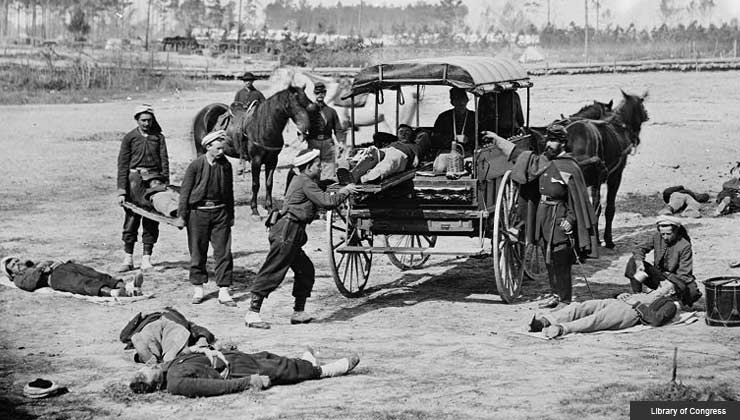
An ambulance crew demonstrates the removal of wounded soldiers from the field during the Civil War.
En español | Echoes of the nation'south greatest fight — the Civil War — notwithstanding reverberate from coast to declension.
Some ring potent: of course the end of slavery, perhaps the worst disgrace in the nation's history. And the 620,000 ancestors lost. Other vestiges take weakened with the passage of time but are no less legacies of the four horrific, heroic years that shaped us as i nation.
Here are 8 ways the Civil War indelibly changed us and how we live:
i. Nosotros have ambulances and hospitals.
The Ceremonious State of war began during medieval medicine's last gasp and concluded at the dawn of modern medicine. Each side entered the war with puny squads of physicians trained by textbook, if at all. Iv years later, legions of field-tested doctors, well-versed in anatomy, anesthesia and surgical exercise, were poised to make great medical leaps.
The nation'south first ambulance corps, organized to blitz wounded soldiers to battlefront hospitals and using wagons developed and deployed for that purpose, was created during the Civil War. The idea was to collect wounded soldiers from the field, take them to a dressing station and then ship them to the field infirmary.
Doctors laid out the hospitals as camps divided into well-divers wards for specific activities such as surgery and convalescence. Women flocked to serve these hospitals as nurses.
Before the state of war, near people received health intendance at dwelling house. After the war, hospitals adapted from the battlefront model cropped upwardly all over the country. The ambulance and nurses' corps became fixtures, with the Ceremonious War's most famous nurse, Clara Barton, going on to establish the American Crimson Cross. Today's modern hospital is a direct descendant of these offset medical centers.
ii. Nosotros prize America as a country of opportunity.
The Civil State of war paved the way for Americans to live, learn and move nigh in ways that had seemed all merely inconceivable only a few years earlier. With these doors of opportunity open, the Usa experienced rapid economical growth. Immigrants also began seeing the fast-growing nation every bit a land of opportunity and began coming here in record numbers.
For many years Southern lawmakers had blocked the passage of state-grant legislation. Only they weren't around after secession, and in 1862 Congress passed a series of state-grant measures that would forever modify America'south political, economic and physical landscape:
- The Starting time Transcontinental Railroad. Also known every bit the "Pacific Railroad," the earth's get-go transcontinental line, built between 1863 and 1869, was at least partly intended to demark California to the Marriage during the Civil War. To build the line, the Wedlock Pacific and Key Pacific railroads were granted 400-foot rights-of-style plus x square miles of authorities-owned country for every mile of track built.
- Homesteading in the West. The Homestead Act, enacted in 1862, provided that any adult citizen (or intended citizen who had never borne arms confronting the U.Due south. regime) could be granted 160 acres of surveyed government country later living on it — and making improvements to information technology — for five years. Afterwards the Ceremonious War, Matrimony soldiers could deduct the time they had served from the residency requirement.
- The land-grant college arrangement. The Morrill Land Grant Act authorized the sale of public lands in every state to underwrite the establishment of colleges dedicated to the "agricultural and mechanical arts." It likewise required the teaching of military tactics. In time, the new law would give rising to such institutions of higher learning as Michigan State, Texas A&M and Virginia Tech.
The aforementioned year brought another innovation — a national newspaper currency — that would literally bankroll the rapidly expanding government and at the same time grease the wheels of commerce from coast to coast. In 1862, with the Marriage's expenses mounting, the regime had no way to continue paying for the war. "Immediate action is of great importance," Treasury Secretarial assistant Salmon P. Chase told Congress. "The treasury is well-nigh empty." The solution: treasury notes bearing no interest and printed on the all-time banking newspaper, as proposed to President Abraham Lincoln by Col. Edmund D. Taylor, who would later on became known as "the begetter of the greenback."
Nikki Kahn/The Washington Post/Getty Images
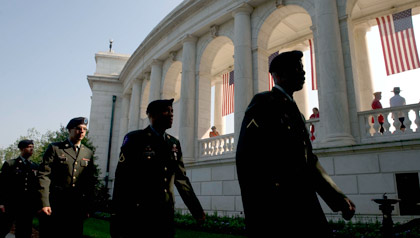
U.S. Regular army soldiers file past the amphitheater at Arlington National Cemetery on Memorial Day 2010.
3. We begin summer with a tribute to fallen soldiers.
Ever wonder why we display flags and memorialize fallen solders merely as summer gets under way? Flowers, that's why.
The commencement memorial days were group events organized in 1865 in both the South and North, by black and white, just a month after the war ended. Quickly evolving into an annual tradition, these "decoration days" were ordinarily gear up for early summer, when the about flowers would be available to lay on headstones.
Decoration days helped the torn nation heal from its wounds. People told — and retold — their war stories, honored the feats of local heroes, reconciled with former foes.
After Earth War I, communities expanded the holiday to honor all who have died in military service, although the official national observance didn't begin until 1971.
This year Memorial Day falls on May 30.
No matter where yous are on Memorial Day, a national moment of remembrance takes place at 3 p.m. local time.
4. We let engineering guide how we communicate.
Abraham Lincoln was a techie. A product of the Industrial Revolution, Lincoln is the only president to have held a patent (for a device to buoy boats over shoals). He was fascinated with the idea of applying technology to war: In 1861, for example, after being impressed past a demonstration of ideas for balloon reconnaissance, he established the Airship Corps, which would shortly begin floating hot-air balloons to a higher place Confederate camps in acts of aerial espionage.
Lincoln also encouraged the evolution of rapid-fire weapons to modernize combat. Pulitzer Prize-winning historian James McPherson, the author of Tried by War: Abraham Lincoln every bit Commander in Chief, notes that Lincoln personally tested the "coffee-manufactory gun," an early version of a manus-cranked machine gun.
Just to a higher place all, Lincoln loved the telegram. Invented only a few decades earlier, the telegraph system had gone national in 1844.
Equally Tom Wheeler recounts in his volume, Mr. Lincoln's T-Mails: The Untold Story of How Abraham Lincoln Used the Telegraph to Win the Civil War, the White Firm had no telegraph connexion. Twice daily throughout his presidency, Lincoln walked to the telegraph part of the State of war Department (on the site of today's Eisenhower Executive Office Building, just west of the White House) to receive updates and to send orders to his generals on the front end. He sent this ane to Full general Ulysses Southward. Grant on Aug. 17, 1864: "Hold on with a bull-dog grip, and chew & choke, as much every bit possible."
Before Lincoln's day, letters and speeches were ofttimes long-winded. With the telegraph came the need for curtailed communication. Afterwards all, every dot and dash of Morse Code carried a toll. Gone were the "wherefores," "herewith" and "hences." Flowery, formal speech was out.
Lincoln'due south Gettysburg and Second Inaugural addresses both demonstrate this new economy of phrase. "Events were moving too fast for the more languid phrases of the past," historian Garry Wills writes in his book Lincoln at Gettysburg. "The fob, of course, was not merely to be cursory but to say a peachy deal in the fewest words. Lincoln justly boasted, of his Second Inaugural's six hundred words, 'Lots of wisdom in that document, I suspect.'"
Non only did Lincoln's wartime dependence on the telegraph eventually pb to a wave of investment in new advice devices, from the telephone to the Internet (the latter invented, not coincidentally, for military use), but it also signaled the evolution of a language that morphs as quickly as the devices that instantaneously tweet our words effectually the world.
Udo Keppler/Library of Congress
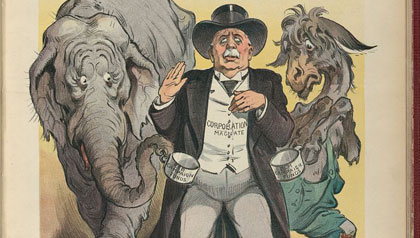
A 1905 cover of Puck mag employs the ass and elephant as satirical stand up-ins for the political parties that took permanent hold during the Ceremonious War.
5. We place ourselves as Democrats and Republicans.
Before 1854, you might have been a Whig. Or a Free Soiler. But that year the Republican Party was founded by anti-slavery activists and refugees from other political parties to fight the iron grip of powerful southern Democrats.
Every bit the proper noun of their party suggests, these activists believed that the republic'due south interests should take precedence over the states'. In the years before the war, many northern Democrats defected to join the new party — and, in 1860, to elect Abraham Lincoln as the first Republican president — while southern Democrats led the march to secession.
The Democratic and Republican parties both survived the war and have held their spots equally the dominant U.South. political parties always since. The "Solid S," as information technology was known, protected the interests of agrarian Southern whites and consistently elected Democrats to Congress from Reconstruction through the early 1960s, when the national Autonomous Party's back up of the civil rights movement allowed the Republican Political party to begin making new political inroads beneath the Bricklayer-Dixon Line.
Within a few years, Northward and S swapped political party hats. Bourgeois southerners grew disenchanted with the Autonomous Party's increasingly progressive platforms. Republicans capitalized on this with their "Southern Strategy," an organized plan to make headway at that place on a socially conservative, states' rights platform. In reverse, historically Republican strongholds in the Northeast began voting Democrat, establishing the pattern of crimson and blue that we see on election-nighttime maps today.
Alexander Gardner/Library of Congress
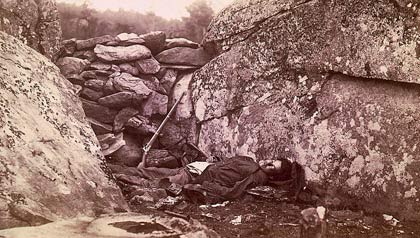
This 1863 photograph shows a dead Confederate sharpshooter after the Battle of Gettysburg.
six. We see war "upwardly close and personal."
The Civil State of war was the first war in which people at domicile could absorb battle news before the smoke cleared. Eyewitness accounts by reporters and soldiers were relayed via telegraph to the country's 2,500 newspapers, printed most immediately and and then read voraciously by citizens desperate to know how their boys were faring. The Ceremonious State of war created a tradition of intimate war reportage that is still with us today.
Accept this extract from a dispatch from George Townsend, who was just twenty when he began to comprehend the state of war for the New York Herald: "In many wounds the assurance nevertheless remained, and the discolored flesh was bloated unnaturally. In that location were some who had been shot in the bowels, and at present and and then they were frightfully convulsed, breaking into shrieks and shouts. Some of them iterated a unmarried word, as, 'md,' or 'help,' or 'God,' or 'oh!' commencing with a loud spasmodic cry, and continuing the same word till it died abroad in cadency. The deed of calling seemed to lull the pain. Many were unconscious and lethargic, moving their finger, and lips mechanically, but never more to open their eyes upon the low-cal; they were already going through the valley and the shadow."
Tony Horwitz, a former war correspondent and the author of Confederates in the Attic and the forthcoming Midnight Rising: John Brownish and the Raid That Sparked the Civil State of war, says that the front-line dispatches influenced his modern battlefront reporting. "Having been moved past soldiers' writing from the 1860s, I as well sought them on strange battlefields, even going through the pockets of the Iranian dead at Majnoon and getting a Farsi speaker to translate letters and diaries for me," he says. "This sounds ghoulish, I know, merely I recollect you need to personalize the dead to bring dwelling the shock and tragedy of it all. Otherwise, they're merely statistics."
Photography, still in its infancy, was non yet a part of the daily news cycle. But the Civil State of war was the start such conflict recorded by photographers (the near famous of whom was Mathew Brady). Because the primitive moisture-plate technology of the era required that subjects be still at the moment the camera'due south shutter snapped, images of the era draw nearly every attribute of the war but one: battle. But that in time would change, as well.
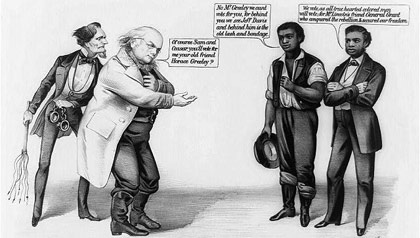
Currier & Ives/Library of Congress
A political drawing by Currier & Ives depicts Horace Greeley, the paper editor and anti-slavery activist, and Jefferson Davis, the leader of the Confederacy during the Ceremonious War.
seven. Nosotros hold certain rights to be sacred.
Recall of these three amendments to the U.Due south. Constitution, all ratified within five years of the end of the Civil War:
- 13th Subpoena (1865). Department 1. Neither slavery nor involuntary servitude, except as a punishment for criminal offence whereof the party shall have been duly convicted, shall exist within the Us, or whatever place subject to their jurisdiction. ...
- 14th Amendment (1868). Section one. All persons born or naturalized in the United States, and subject to the jurisdiction thereof, are citizens of the Usa and of the State wherein they reside. ...
- 15th Amendment (1870). Section 1. The right of citizens of the U.s.a. to vote shall not be denied or abridged past the United States or by whatsoever State on account of race, color, or previous status of servitude. ...
Before the Ceremonious War, the concept of liberty and justice for all meant little unless you lot were white and male person. Going beyond the abolitionism of slavery, the 14th and 15th amendments were the first extensions of citizenship and voting rights to minority groups.
Of grade, half of us — women — went without a voice until 1920, but the postwar laws set a precedent that eventually would lead to suffrage for all adults. Imperfect in exercise over the side by side 100 years, voting rights finally gained protection through the 1964 Civil Rights Human activity, ensuring that discrimination could never again disenfranchise any U.S. citizen.
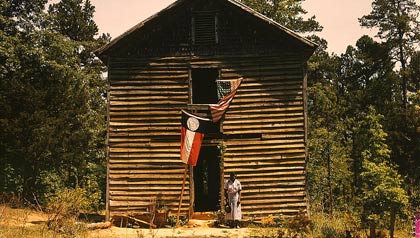
Jack Delano/Library of Congress
An unidentified woman stands in forepart of a edifice in Georgia that displays both the state and U.Due south. flags.
viii. We're all Americans.
Information technology took the War Between u.s. to make u.s.a. 1 nation, indivisible. Before 1861, the United States were loosely tied entities and always described every bit a plural noun, as in, "The United States are in trade with French republic."
The war's bloodiest battle came at Gettysburg in 1863, with 51,000 casualties in just 3 days. Although the Matrimony stopped Confederate Gen. Robert Eastward. Lee's Northern invasion, immature men'south bodies littered the farms and gardens that had turned into a battleground. Was the preservation of these united states worth the cost in claret?
At a memorial for the expressionless, Lincoln intentionally chosen on the Matrimony to persevere for a unmarried national ideal: "[T]hat we here highly resolve that these dead shall not have died in vain — that this nation, under God, shall have a new birth of freedom — and that government of the people, by the people, for the people, shall not perish from the earth."
The effect of Lincoln's Gettysburg Address, but 272 words from beginning to end, was radical and firsthand. "By accepting the Gettysburg Address, its concept of a single people dedicated to a proposition, we have been changed," Wills writes. "Because of it, nosotros live in a different America."
But the shift was more than a statesman'south creation. It was also forged in the experience of hunger, disease, claret and death shared for four years by the Union and Confederacy alike. Tellingly, the tradition of Civil War reenactments began even earlier the conflict had ended, as returning soldiers recreated battleground scenes at home to educate the denizens and pay tribute to their fallen comrades.
Ken and Ric Burns, in their introduction to the book The Ceremonious State of war, write: "Some events so pervasively condition the life of a civilisation that they retain the power to fascinate permanently. They become the focus of myth and the anchor of meaning for a whole society."
The Civil War became our anchor. Ever since, whether big authorities or small regime, whether doves or hawks, black or white, we have all been ane thing: Americans.
Betsy Towner lives in California.
pattersonyous1990.blogspot.com
Source: https://www.aarp.org/politics-society/history/info-04-2011/8-ways-civil-war-changed-lives.html
0 Response to "the South Is Fighting the Civil War All Over Again"
Enregistrer un commentaire