Vintage Person. Ive Been Around So Long Im in Style Again
Within the fight to take back the plumbing fixtures room, led by designers similar Melissa McCarthy, startups like Le Tote and shoppers like you lot
Inside the fight to take back the fitting room
By Eliana Dockterman
I take e'er hated fitting rooms. It's non just that I hate the mirrors meant to trick me into thinking I'm skinnier or the curtains that never close all the way so strangers tin glimpse me trying to squirm into too-tight jeans. What I actually hate is why I have to go to fitting rooms in the start place: to meet if I've distilled my unique trunk shape down to 1 magic number, knowing total well that I probably won't be right, and it definitely won't be magic. I hate that I'm embarrassed to ask a salesperson for help, every bit if it'southward somehow my error that I'one thousand non short or alpine or curvy or skinny enough to match an industry standard. I hate that it feels like nothing fits.
And I'k non lonely. "What'south your size?" has always been a loaded question, but it has become about impossible to reply in recent years. The rise of so-called vanity sizing has rendered most labels meaningless. As Americans take grown physically larger, brands have shifted their metrics to make shoppers feel skinnier—so much and then that a women'southward size 12 in 1958 is now a size vi. Those numbers are fifty-fifty more confusing given that a pair of size-6 jeans can vary in the waistband by as much as 6 in., co-ordinate to one estimate. They're besides discriminatory: 67% of American women wear a size 14 or above, and most stores don't carry those numbers, nevertheless capricious they may be.
"Insanity sizing," equally some have dubbed this trend, is frustrating enough for shoppers who try on clothes in stores. But now that $240 billion worth of apparel is purchased online each twelvemonth, it has get a source of epic wastefulness. Customers return an estimated 40% of what they buy online, mostly considering of sizing issues. That's a hassle for shoppers and a costly nightmare for retailers, who at present spend billions roofing "complimentary" returns.
Clearly, modern fashion has a fit trouble. And while it does affect men, whose shirts and jeans rarely bear honest measurements, it'south a much more than sweeping upshot for women—non just because we accept more clothing options but also because we are more than closely scrutinized for what we wear. When we get married or interview for a chore or play professional sports or run for President of the U.s.a., nosotros encounter a whole set of standards and expectations. Nosotros can be shamed for an outfit that'due south too slutty, too dowdy, too pricy—take your pick. That's the burden women carry into the fitting room. And when we tin't find clothes that fit, allow alone clothes we like, it can be infuriating.
The debate over sizing is an emotional one, particularly right now, when so many shoppers are rejecting labels of all kinds, from sexual orientation to gender to, yeah, size. For decades, major retailers take by and large catered to one (white, slim) consumer even as America has gotten more diverse. Now shoppers are pushing back. They're turning away from stores like Victoria'due south Secret that market a single way to be sexy. They're demanding that mass-market chains like Forever 21 carry a wider range of sizes in-store. Even celebrities, like Beyoncé and Melissa McCarthy, are calling out high-style designers for ignoring the millions of women with curvier figures.
Only underlying it all is the same maddening question: At a time when consumers are more vocal than ever virtually what they want and need, and retailers are losing money by sticking with the status quo, and tech companies accept streamlined every other part of the shopping process, why is it still so hard to find clothes that fit? And what, if annihilation, can be washed virtually it?
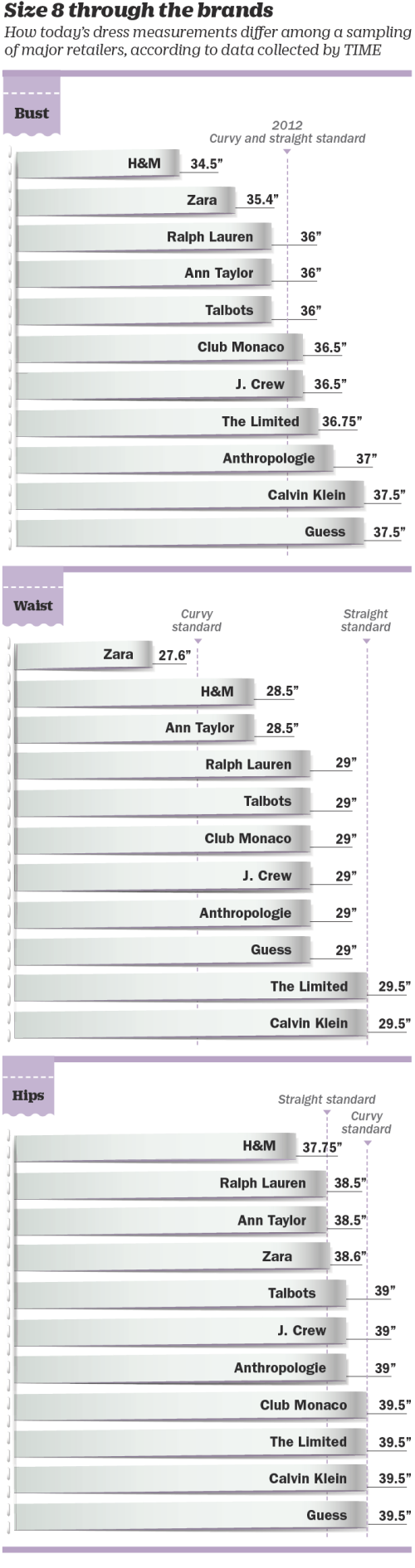
I'm within an office closet in San Francisco holding two different dresses, both made by the same brand, both labeled size "pocket-sized." They've been handed to me by Ruth Hartman, the primary merchandising officer of Le Tote, a startup that measures clothing from major brands in order to recommend the right fit, rather than simply the right size, to customers. When I try on the dresses, it's immediately clear why such a company exists: The first one is tight plenty that I struggle to exhale. The second balloons effectually me.
Hartman nods knowingly. "It'southward common," she says. "I always try on four pairs of a size-8 jean in the same brand because they all fit differently." The predicament is so absurd, information technology sounds like a joke. (In fact, it is one on NBC'due south upcoming comedy The Skilful Place, gear up in a sky-like locale where there'southward a bazaar called Everything Fits.)
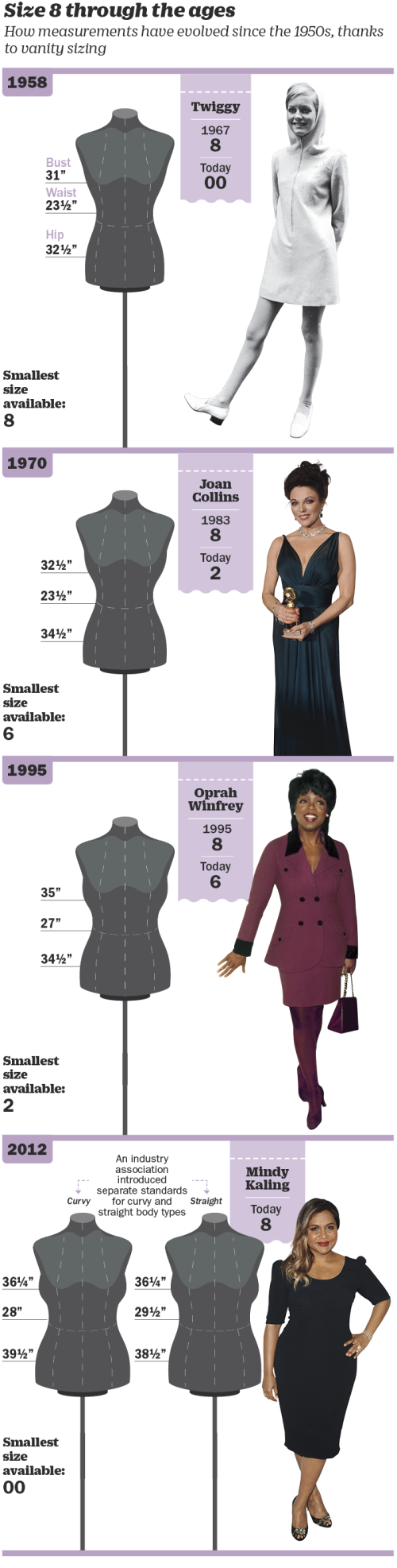
This madness is partly our own fault. Studies have shown that shoppers prefer to buy vesture labeled with small sizes because it boosts our confidence. So as the weight of the average American woman rose, from 140 lb. in 1960 to 168.5 lb. in 2014, brands adjusted their metrics to help more than of us squeeze into more-desirable sizes (and get us to buy more than apparel). Over time this created an arms race, and retailers went to extremes trying to ane-up ane another. Past the late 2000s, standard sizes had become so forgiving that designers introduced new ones (0, 00) to make up the departure. This was a workable issue—albeit an annoying 1—and then long as women shopped in physical stores with assistance from clerks who knew which sizes ran big and small-scale.
Then came the Internet. People started buying more clothes online, trying them on at habitation, realizing that null fit, and sending them dorsum. And retailers got stuck with the bills—for ii-manner aircraft, inspection and repair. Now vanity sizing, which was in one case a reliable sales gimmick, sucks upwardly billions of dollars in profits each year.
So why don't retailers just stop doing it? In theory, many (or even most) of them could agree to 1 standardized ready of measurements, every bit mattress companies do, so customers would know exactly what they're getting when they order a "size 12" dress. This tactic, known as universal sizing, is increasingly existence discussed on fashion blogs and at industry gatherings equally a common-sense solution to America'south crisis. But there'due south a very good reason it won't work. And to understand why, it helps to sympathize how sizing came to exist in the first place.
I'm at a boutique in Rome, surrounded by retro-chic clothes that would look correct at dwelling house in Betty Draper's closet—bold patterns, colorful capes, loftier-waisted skirts. Information technology feels oddly appropriate, given that I'm hither to be measured for a custom dress, something near American women oasis't done since the 1950s.
The designer is Tina Sondergaard, a Danish woman who opened her first store in Rome in 1988. Since then, she says, she has outfitted everyone from hotshot executives to Italian rock stars to a German language princess who "drove by on her Vespa, left information technology in the middle of the street, walked into my store and said, 'I need that clothes.'" By comparison, an American journalist is probably not that exciting. But if Sondergaard is thinking that, it never shows.
As she takes my measurements, I'm struck by how many choices I have. Practise I want to show off my arms or hibernate them? Do I want to emphasize my waist? My legs? "Back in fourth dimension, this is what people used to exercise," Sondergaard tells me, explaining how sizing worked for near of human history. If women were wealthy, they had their clothes made. If they weren't, they made their own. Either manner, garments adhered to the contours of their bodies amend than anything off the rack ever could.
In America, those cultural norms started to shift during the Great Depression, when barely anyone could afford to buy food, let lone fabric. At the same time, industrial techniques were improving, making information technology cheaper for companies to mass-produce wearing apparel. By the cease of World State of war II, those factors—alongside the ascent of advertisement and mail-order catalogs—had sparked a consumer revolution, both at home and abroad. Made to measure out was out. Off the rack was in.
And sizes arrived. In the early 1940s, the New Deal–born Works Projects Administration commissioned a study of the female body in the hopes of creating a standard labeling system. (Until then, sizes had been based exclusively on bosom measurements.) The study took 59 distinct measurements of xv,000 women—everything from shoulder width to thigh girth. But the most consequential discovery by researchers Ruth O'Brien and William Shelton was psychological: women didn't desire to share their measurements with shopping clerks. For a organization to work, they concluded, the government would accept to create an "arbitrary" metric, like shoe size, instead of "anthropometrical measurement[s]."
So information technology did. In 1958, the National Institute of Standards and Engineering put forth a fix of even numbers 8 through 38 to represent overall size and a set of letters (T, R, S) and symbols (+, —) to correspond meridian and girth, respectively, based on O'Brien and Shelton'due south enquiry. Brands were advised to make their clothes appropriately. In other words: America had research-backed, authorities-approved universal sizing—decades ago.
But by 1983, that standard had fallen by the wayside. And experts debate it would fail now too, for the same reason: there is no "standard" U.S. body blazon. Universal sizing works in Cathay, for case, because "being plus-sized is then unusual, they don't even have a term for information technology," says Lynn Boorady, a professor at Buffalo State Academy who specializes in sizing. But America is home to women of many shapes and sizes. Enforcing a single fix of metrics might make information technology easier for some of them to shop—like the thinner, white women on whom O'Brien and Shelton based all of their measurements. Just "nosotros're going to go out out more than people than nosotros include," Boorady says.
Then once again, the majority of American women are existence left out right now.
I'chiliad in a fitting room at Brandy Melville in New York City, a few steps from a sign promising that "one size fits most." At this store, there are no sizes—just racks of sweatshirts, ingather-tops and brusk-shorts whose aesthetic could be described as Coachella-meets-pajamas. Many of Brandy Melville's teen and tween fans love this approach, in part because they tin can all endeavour on the same clothes.
For me, it'due south a mixed feel. I'thou five ft. nine in. and, though we've already established sizing is meaningless, the clothes in my closet are mostly sizes iv or vi. Only when I try on the stretchy shorts and skirts, the fit is and so tight it feels like I'm wearing underwear. Immediately I understand why critics say this store fuels body-image issues.
Brandy Melville denies it's exclusionary. "Anyone can come in the store and find something," its visual manager, Sairlight Saller, told USA Today in 2022 (the retailer declined to annotate for this commodity). "At other places, sure people can't find things at all." The beginning statement is patently false: no one store can fit every human body. But the second is spot-on. Some of Brandy Melville's looser tops did fit me, and they could fit women who are much curvier than I am. Most retailers largely disregard the latter demographic.
This is a misreckoning business policy. The majority of American women wear a size fourteen or above, which is considered "plus size" or "curvy" in the fashion industry. And they're spending more than ever. In the 12-month period ending in February 2016, sales of plus-size apparel hit $xx.4 billion, a 17% increase over that same period catastrophe in February 2013, according to the market-research firm NPD Group.
And yet, the plus-size market is treated as an afterward-idea. Nearly all advertising campaigns feature sparse models. Near designers refuse to make plus-sized habiliment. Some retailers accept even launched plus-size brands only to kill them several years later, as Limited parent L Brands did with Eloquii (which was sold and relaunched by individual investors later an outcry from consumers).
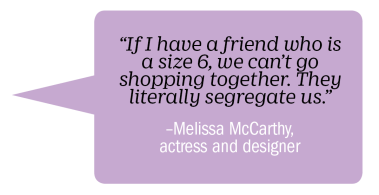
For shoppers, the message is inescapable: if you lot're over a certain size, you don't belong. "It's like we've been taught nosotros all should have third eyes, and if you don't have a third middle, what's wrong with yous?" says McCarthy, the Emmy-winning actress who has been "every shape and size under the rainbow" and is currently a size fourteen. "If you tell people that long enough, in 30 years everyone's going to go, 'You see that ane? She's only got 2 eyes.'" In stores, she adds, the plus-size sections are frequently relegated to obscure areas, like the corner or on a unlike floor, if they exist at all. "If I accept a friend who is a size vi, we can't go shopping together. They literally segregate united states of america. It feels similar y'all're going to detention when you become upwards to the third floor."
McCarthy isn't the only shopper speaking out. Before this year, blogger Corissa Enneking, who calls herself a "happy fat," wrote a viral open letter to Forever 21 after encountering a plus-size section she describes as shoved into a corner "with yellow lights, no mirrors, and zero accessories." "Your reckless disregard of fat people's feelings is shameful," she continued. (At the time, Forever 21 said this wasn't an "accurate representation" of its brand.) Even Beyoncé, at present considered an icon in the way globe, has been vocal about how hard information technology is for women with curves to find apparel. Designers "didn't actually want to wearing apparel four black, country, curvy girls," she has said of her early years with the grouping Destiny's Kid. "My mother was rejected from every exhibit in New York."
Clothing companies say that it'south difficult for them to make and stock larger sizes because information technology requires more cloth, more patterns and more money. That'south all technically true, says Fiona Dieffenbacher, who heads the fashion-blueprint program at the Parsons Schoolhouse of Blueprint. "Merely if y'all accept the volume of a big brand, it'south a no brainer. You're going to get the sales." The more complicated issue, argues SUNY Buffalo State's Boorady, is that most designers still equate "stylish" with "skinny." "They don't want to think of their garments existence worn by plus-size women," she says.
Slowly, those biases are breaking downwardly. Victoria's Secret, for example, is attempting to rebrand itself to emphasize comfort and authenticity ("No padding is sexy," a recent advertizement declares) afterward one of its competitors, Aerie, generated considerable buzz—and sales—by using models with rolls, cellulite and tattoos. Nike is using a plus-size model to sell sports bras. H&1000 is expanding its plus-size collection. And designers are starting to embrace a broader assortment of body shapes. (Consider Christian Siriano's drove with Lane Bryant and McCarthy's line, Seven7, which offer all-encompassing plus-size options.) This is how fashion is supposed to work, says Sondergaard, the Danish dressmaker. "Many designers say, This is the clothes, permit'due south try to fit people into this. Only it'southward the opposite: You lot look at people, and say, Let's effort to fit a dress for this body."
Even equally sizing becomes more inclusive, however, confusion persists: "size 20" is merely as meaningless every bit "size 6." And for now, at least, the solution isn't design. It's data.
I'thousand in my apartment in New York, well-nigh to open a box that I'chiliad told represents the future of retail. It'southward come courtesy of Le Tote, the startup I visited in San Francisco. Here's how the service works: I spend a few minutes awkwardly taking my ain measurements with a measuring record. Then I send that information to Le Tote, which runs my actual size—not the arbitrary numerical one—through its massive database of clothing measurements. Days later, I get a box of outfits picked specifically for my body.
The algorithm behind it all is called Chloe, and it's more encyclopedic than whatsoever human salesclerk. In addition to tracking my shape, Chloe tin can track my likes and dislikes. If I go a pair of fellow jeans that hang too loose, for example, I can tell Chloe I don't like that style, even though it technically fits. Adjacent time Chloe volition know to size down.
Online retailers are salivating over technology like this, which may well enable them to win more customers. Truthful Fit, a Boston-based startup with its own database of measurements, works with more than 10,000 brands, including Nordstrom, Adidas and Kate Spade. Its algorithm asks shoppers to enter the size and brand of their all-time-fitting shoe, shirt, dress, etc.; so it recommends products appropriately.
These services aren't perfect. Le Tote, for instance, doesn't yet offering petite and plus-size options, nor exercise many of the brands that work with True Fit. And it's hard to predict personal mode. As Truthful Fit co-founder Romney Evans puts information technology, "Yous can accept someone who technically fits into a horizontally striped jumpsuit but hates Beetlejuice." To its credit, though, Chloe found clothes that worked well for my body. When I opened the Le Tote box, virtually everything fit.
So, are we close to solving the sizing crisis? Yep and no. Startups like True Fit and Le Tote are certainly taking steps in the right direction, cutting through the chaos of Internet shopping to offering clear, actionable intel. Ditto brands like Aerie and designers like McCarthy, who are proving that it'due south practiced business concern to push the boundaries of traditional sizing.
There are many other entities trying to beginning a retail revolution. Amongst them: Torso Labs, which creates three-D fit models of the human body; Amazon, which recently patented a Truthful Fit-like algorithm; Gwynnie Bee, which offers a clothing subscription service for plus-size women; and Fame & Partners, which allows shoppers to design their own dresses. It'southward as well early to tell which ones will succeed.
But even if all of them flourish and sizing becomes radically inclusive and transparent, there'southward no guarantee that we—the shoppers—will like what we meet in the mirror. Vanity sizing works because, deep downward, we're all a little vain. And no matter how many strides it makes, the manner industry can't change its raison d'être: to make us feel like better versions of ourselves, one outfit at a time. Sometimes, that requires deception. Often, it drives usa crazy. That'south why I hate plumbing fixtures rooms—until I notice something I love. •
Graphic sources: Lynn Boorady, SUNY Buffalo State; ASTM International; Getty Images; People magazine; NPR
Photos: Twiggy, Kaling: Getty Images; Collins: AP; Winfrey: Dave Allocca—DMI/The LIFE Flick Collection/Getty Images
Correction: The original version of this story mischaracterized the number of partners/collaborators of the startup True Fit. As of August, the company works with more than than 10,000 brands.
pattersonyous1990.blogspot.com
Source: https://time.com/how-to-fix-vanity-sizing/
0 Response to "Vintage Person. Ive Been Around So Long Im in Style Again"
Enregistrer un commentaire